Basic HTML Version


14
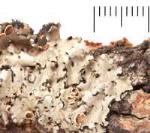
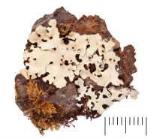
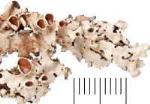
Myelochroa irrugans
(Hue) Elix & Hale, Mycotaxon 29: 241
(1987).
Syn.:
Parmelia irrugans
Nyl., Lich. Jap. 26 (1890).
Description:
Thallus 4–10 cm wide, loosely adnate to
imbricate, lobes 2–4 mm wide with dentate to crenulate
margins with short cilia in lobe axils; upper surface greenish
mineral grey to yellowish grey, older parts becoming
foveolate, developing c. 1 mm wide lobules; medulla pale–
yellow to white; lower surface brown to black, rhizines
simple to squarrosely branched. Cortex K+ yellow; atranorin.
Medulla K–, C–, KC–, P-; zeorin, leucotylic acid, leucotylin
and related triterpenoids, secalonic acid (minor).
Distinguished from
M. entotheiochroa
by the presence of
laminal lobules on the older parts and the absence of a
heavily wrinkled and rugose upper surface, and from
M.
siamea
which has galbinic acid (K+ yellow, P+ orange–red).
Ecology and distribution:
Rare on twigs in a moss forest
around a montane bog at 2590 m in Chiang Mai Province,
Doi Inthanon National Park. Asian distribution: reported
from Japan, Korea, Saghalien, China, Taiwan, Nepal,
Thailand (KUROKAWA & LAI 2001; WOLSELEY et al.
2002) and India (DIVAKAR & UPRETI 2005).
23
Rhizines dichotomously branched. Medulla KC+
orange
24
24
Medulla P+ orange-red, KC- (protocetraric)
Hypotrachyna adducta (Nyl.) Hale
Hypotrachyna adducta
(Nyl.) Hale, Phytologia 28: 340
(1974).
Syn.:
Parmelia adducta
Nyl., Flora 68: 610 (1885).
Description:
Thallus adnate 2–4 cm wide; lobes sinuous, 2–4
mm wide; upper surface grey, smooth, emaculate, isidia and
soredia absent; lower surface black, densely rhizinate to
margins, rhizines simple and dichotomously branched.
Cortex K+ yellow; atranorin. Medulla K- or K+ brownish, C–
, KC–, P+ orange–red; protocetraric acid and unknown.
Distinguished from other species by presence of protocetraric
acid.
Ecology and distribution:
Corticolous, on
Pinus kesiya
in Chiang Mai Province, Doi Suthep National Park at 1400 m
and on
Pinus
sp. along roadside at 2450 m in Chom Thong
District, Doi Inthanon; also reported from Doi Inthanon by
POOPRANG et al. (1999). Known from the E Himalayan
regions of India and Nepal, Japan, Philippines, Papua New
Guinea, Taiwan (DIVAKAR & UPRETI 2005) and New
Caledonia (LOUWHOFF & ELIX 2002).
24
Medulla P-, KC+ orange (barbatic)
25
25
Lobes 2-6 mm wide
Hypotrachyna physcioides (Nyl.) Hale
Hypotrachyna physcioides
(Nyl.) Hale, Smiths. Contr. Bot.
25: 58 (1975).
Syn.:
Parmelia physcioides
Nyl., Synopis Methodica
Lichenum 1: 385 (1860);
Hypotrachyna scytodes
(Kurok.)
Hale, Phytologia 28: 341 (1974).
Description:
Thallus very
variable; Asian specimens typically with irregularly
branching, sublinear, 2–6 mm wide lobes, subcontiguous to
imbricate centrally, lacking isidia and soredia. Lower surface
black, densely rhizinate to margins. Cortex K+ yellow;
atranorin. Medulla K–, C– or C+ orange, KC+ orange, P–;
barbatic acid (major), 4–O–demethylbarbatic acid (major).
This species can be confused with
H. ducalis
which is
morphologically similar but contains anziaic acid in addition