Basic HTML Version


15
to barbatic and demethylbarbatic acids and the medulla is
C+red.
Ecology and distribution:
A common corticolous
species, in semi–open evergreen forest with
Pinus
and dry
dipterocarp species at 900–1000 m, in oak/chestnut forests at
1550–1600 m, on exposed, open limestone ridge vegetation
at 2000 m, in high elevation, mature but open Fagaceae
forests at 1950–2100 m, and in a moss forest on edge of
alpine meadow at 2300–2450 m. Throughout the neotropics
and in SE Asia (DIVAKAR & UPRETI 2005).
25
Lobes 1-2 mm wide
Hypotrachyna chlorobarbatica Elix & Pooprang
Hypotrachyna chlorobarbatica
Elix & Pooprang in
Pooprang et al., Mycotaxon 71: 113 (1999).
Description:
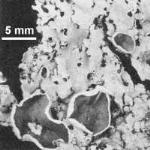
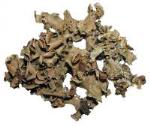
Thallus adnate, eciliate, lobes 1–2 mm wide;
upper surface pale grey, lacking isidia and soredia; lower
surface black, rhizines dense, branched, black.
H.
chlorobarbatica
and
H. exsecta
show similar chemistry on
TLC plate, but the latter can be distinguished by the presence
of soredia. Cortex K+ yellow; atranorin. Medulla K–, C+
orange, KC+ deep orange, P–; barbatic acid. Distinguished
from
H. exsecta
by the absence of soredia.
Ecology and
distribution:
Endemic to Thailand and described from Khao
Yai National Park in the Nakhon Ratchisma Province.
Corticolous in undisturbed evergreen forest at 1450 m in
Chiang Mai Province, Doi Suthep National Park.
26
Rhizines simple or weakly and irregularly branched
27
26
Rhizines richly and dichotomously branched
29
27
Lobes 5-8 mm wide, with cilia along the margins
Parmotrema subcaperatum (Kremp.) Hale
Parmotrema subcaperatum
(Kremp.) Hale
Syn.:
Canomaculina subcaperata
(Kremp.) Elix, Mycotaxon
65: 477 (1997);
Parmelia subcaperata
Kremp., Vidensk.
Meddel. Dansk Naturhist. Foren. Kjøbenhavn 25: 10 (1874);
Rimeliella subcaperata
(Kremp.) Kurok., Ann. Tsukuba Bot.
Gard. 10:7 (1991).
Description:
Thallus loosely adnate, 7–
15(–20) cm wide, lobes 5–8 mm wide, sparsely ciliate along
margins; upper surface lacking soredia and isidia; lower
surface black, with short, simple rhizines extending to the
margins. Cortex K+ yellow; atranorin. Medulla K+ yellow
turning red, C–, KC–, P+ orange red; salazinic acid. The
lower surface is usually only black at the centre (ELIX
1994b), but material from Thailand was black to the margins.
Distinguished from other species with salazinic acid and
rhizines continuous to the margins by the absence of soredia
and isidia.
Ecology and distribution:
A new record for
Thailand where it is rare in a montane evergreen forest
(single locality: Chiang Mai Province, Doi Suthep National
Park, forest adjacent to Phuping Palace). This species is
common on rock but less so on bark (ELIX 1997); also
known from S America, E Africa and Australia (ELIX
1994b).
27
Lobes 1-5 mm wide, with sparse cilia confined to the
axils
28
28
Rhizines all simple. Spores 5-7 x 4 micron
Parmelinella simplicior (Hale) Elix & Hale