Basic HTML Version


16
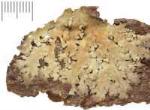
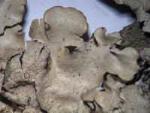
Parmelinella simplicior
(Hale) Elix & Hale, Mycotaxon 29:
242 (1987).
Syn.:
Parmelia simplicior
Hale, Bryologist 75: 99 (1972).
Description:
Thallus 8–10 cm, adnate, lobes elongate or
subirregular, becoming imbricate, (3–)4–5 mm wide, sparsely
ciliate; upper cortex mineral to brownish grey, lacking
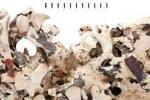
soredia and isidia; medulla white; lower surface black,
±brown erhizinate zone near lobe apices, rhizines sparse,
simple. Cortex K+ yellow; atranorin. Medulla K+ yellow
turning red, C–, KC–, P+ orange; salazinic acid.
Distinguished from
P. wallichiana
by the absence of isidia
and by
P. chozubae
by the much smaller spores.
Ecology and
distribution:
Corticolous in undisturbed evergreen forests at
1200–1450 m in Phitsanulok and Chiang Mai Provinces.
Reported from the Western Ghat, India and E Africa (HALE
1976c; DIVAKAR & UPRETI 2005).
28
Some rhizines forked. Spores 9-17 x 5-12 micron
Parmelinella chozoubae (Singh & Sinha) Elix & Pooprang
Parmelinella chozoubae
(Singh & Sinha) Elix & Pooprang,
Mycotaxon, 71: 121 (1999).
Syn.:
Parmelina chozubae
Singh & Sinha, Nordic J. Bot, 13:
463 (1993).
Description:
Thallus 8–10 cm, adnate,
coriaceous; lobes sublinear, 1-4 mm wide, sparsely ciliate;
upper cortex mineral to brownish grey, rugose, lacking
soredia and isidia; medulla white; lower surface black;
rhizines sparse, simple and furcate. Cortex K+ yellow;
atranorin. Medulla K+ yellow turning red, C–, KC–, P+
orange; salazinic acid, consalazinic acid and secalonic acid
A. Distinguished from
P. wallichiana
by the absence of isidia
and by
P. simplicior
by the much larger spores.
Ecology and
distribution:
Described and previously known only for
Nagaland in India, this species was reported as new to
Thailand by POOPRANG et al. (1999): Chiang Mai
Province, Doi Suthep Pui, on bark of
Pinus kesiya
in a mixed
deciduous forest at 1450 m; we have not seen the specimen.
Also reported from China (CHIEN & WANG 2003).
29
Upper surface pustulate
Hypotrachyna kingii (Hale) Hale
Hypotrachyna kingii
(Hale) Hale, Phytologia 28: 341 (1974).
Syn.:
Parmelia kingii
Hale, J. Jap. Bot. 43: 324 (1968).
Description:
Thallus up to 10 cm wide, loosely adnate, lobes
sublinear and subimbricate, 2–5 mm wide, rounded at the
apices; upper surface mineral grey, flaking, pustulate but not
sorediate; lower surface black, moderately rhizinate with
narrow erhizinate margin. Cortex K+ yellow; atranorin.
Medulla K+ yellow turning red, C–, KC-, P+ orange;
salazinic acid (major), norstictic acid (major). Readily
distinguished by the pustules and the presence of norstictic
and salazinic acids.
H. brevirhiza
produces salazinic acid and
is superficially similar to
H. kingii
; however, it lacks the
additional norstictic acid and has soredia instead of pustules.
H. granulans
has capitate soralia and a shiny, non–flaking
upper surface.
Ecology and distribution:
A first record from
northern Thailand where it is rare in Chiang Mai Province in
evergreen montane forests at 1300 m. Reported from Nakhon
Nayok Province in central Thailand (HALE 1968), Indonesia
and Taiwan (KUROKAWA & LAI 2001).
29
Upper surface not pustulate
30
30
Medulla KC+ red. Without norstictic acid
Hypotrachyna corneola Kurok. & K.H.Moon