Basic HTML Version


17
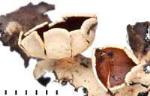
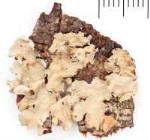
Hypotrachyna corneola
Kurok. & K.H.Moon, Bull. Bot.
Gard. Toyama 5: 12 (2000).
Description:
Thallus loosely adnate to overlapping, to 6 cm
wide with lobes 1.5–5 mm wide, lacking soredia and isidia;
lower surface with dense, richly branched rhizines and a
narrow erhizinate margin. Spores small, 6–7.5 x 5.5 µm.
Cortex K+ yellow; atranorin. Medulla K+ yellow turning red,
C–, KC+ red, P+ orange; salazinic acid, ± pigmentosin A.
Morphologically and chemically similar to
H. coorgiana
,
separated by the larger spores (10–15 vs. 6–7.5 µm long), the
slightly narrower lobes (2–3 vs. 1–5 mm wide) and by the
presence of medullary pigmentosin B (LOUWHOFF & ELIX
2002).
Ecology and distribution:
The first record from
Thailand: Chiang Mai Province, Chiang Dao Wildlife
Sanctuary, on a fallen branch in a mixed pine/dipterocarp
forest at 1585 m. Reported from Papua New Guinea
(KUROKAWA & MOON 2000; LOUWHOFF & ELIX
2002) and the Philippines (ELIX & SCHUMM 2001).
30
Medulla KC-. With norstictic acid
Hypotrachyna masonhalei Patw. & Prabhu
Hypotrachyna masonhalei
Patw. & Prabhu, Bryologist
80(2): 348 (1977).
Description:
Thallus closely adnate, 7-9 cm wide, with
sublinear to linear, 1-2 mm wide lobes, lacking soredia, isidia
and pustules; lower surface dark to margin, with moderately
branched rhizines. Cortex K+ yellow; atranorin. Medulla K+
yellow turning red, C–, KC- , P+ orange; norstictic and
salazinic acids. Readily separated by the presence of
norstictic acid.
Ecology and distribution:
This species,
which was previously known only from India, has been
reported as new to Thailand by POOPRANG et al. (1999)
from Chiang Mai Province, Doi Suthep-Pui, 1400 m, on
Diospyros
in a plantation; we have not examined the
specimen.
31
Medulla K+ yellow turning red (salazinic)
32
31
Medulla K- or K+ dirty brown
33
32
Thallus not strongly maculate and cracked
Parmotrema latissimum (Fée) Hale
Parmotrema latissimum
(Fée) Hale, Phytologia 28: 337
(1974).
Syn.:
Parmelia latissima
Fée, Ess. Crypt., suppl. 119 (1837).
Description:
Thallus ± adnate, up to 25 cm wide, lobes
subirregular and overlapping and 4–5 mm wide with sparsely
ciliate margins; upper surface yellow grey, lacking isidia and
soredia; lower surface black with brown or mottled marginal
zone and rhizines sparse, simple. Cortex K+ yellow;
atranorin. Medulla K+ yellow turning red, C–, KC–, P+
orange; salazinic acid. Thai specimens were immature and
lobe width has been reported as 8–20 mm (DIVAKAR &
UPRETI 2005).
P. cristiferum
is distinguished by soredia and
is more widely distributed.
Ecology and distribution:
First
records for Thailand in the Mae Hong Son Province, Mae
Lao–Mae Sae Wildlife Sanctuary and Chiang Rai Province,
Khun Lao Village, corticolous in evergreen forests at 900 and
1100 m, respectively. Reported from tropical America
(HALE 1965), India (DIVAKAR & UPRETI 2005) and the
Pacific (ELIX & McCARTHY 2008).
32
Thallus strongly maculate and cracked
Parmotrema cetratum (Ach.) Hale