Basic HTML Version


18
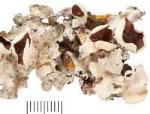
Parmotrema cetratum
(Ach.) Hale, Phytologia 28: 335
(1974).
Syn.:
Parmelia cetrata Ach.
, Syn Meth. Lich.: 198 (1814);
Rimelia cetrata
(Ach.) Hale & A.Fletcher, Bryologist 93: 26
(1990).
Description:
Thallus adnate to loosely adnate, 6–15
cm wide, lobes subirregular, 4–10 mm wide, with dense, 1–2
mm long cilia; upper surface dull grey, maculate, cracked and
lacking soredia and isidia; lower surface brown to black, with
narrow naked margin or rhizines extending to margins.
Cortex K+ yellow; atranorin. Medulla K+ yellow turning red,
C–, KC+ red, P+ deep orange; salazinic acid. Distinguished
from
P. reticulatum
by the absence of soredia and from
P.
nilgherrense
by the presence of salazinic acid.
Ecology and
distribution:
Corticolous in a disturbed evergreen forest at
1350 m in Chiang Mai Province, Doi Suthep National Park,
forest adjacent to Phuping Palace. Reported from Australia,
N and S America, Hawai’i, South Africa (ELIX 1994g),
Thailand (KUROKAWA & LAI 2001), India (DIVAKAR &
UPRETI 2005) and Papua New Guinea (LOUWHOFF &
ELIX 1999).
33
Lobes without cilia along the margins
34
33
Lobes with ciliate margins (sometimes sparse)
37
34
Medulla C+ red (lecanoric). Upper surface maculate
Parmotrema andinum (M
ű
ll.Arg.) Hale
Parmotrema andinum
(M
ű
ll.Arg.) Hale, Phytologia 28: 334
(1974).
Syn.:
Parmelia andina
M
ű
ll.Arg., Revue Mycol. 1:169
(1879).
Description:
Thallus coriaceous, loosely attached up
to 15 cm wide, lobes up to 2 cm wide, rounded, eciliate;
upper surface usually dull, maculate and strongly rugose,
especially on the apothecial margins; lower surface black
with mottled paler margins, sparsely rhizinate. Apothecia
stipitate with perforate disc. Cortex K+ yellow; atranorin.
Medulla K-, C+ red, KC+ red, P-; lecanoric acid.
Distinguished from other species with lecanoric acid by the
absence of soredia, isidia or lobules and the strongly rugose
apothecial margins.
Ecology and distribution:
Corticolous
in evergreen forests above 1000 m in Chiang Mai Province,
Doi Suthep National Park. Reported for Africa (SWINSCOW
& KROG 1988), Tahiti (LOUWHOFF 2000) and Thailand
(WOLSELEY et al. 2002).
34
Medulla C-. Upper surface not maculate
35
35
Medulla K-
Parmotrema pancheri (Hue) Hale
Parmotrema pancheri
(Hue) Hale, Contr. U.S. Natl Herb.,
36: 257 (1965).
Syn.:
Parmelia pancheri
Hue, Nouv. Arch. Mus. Paris, ser.
4, 1: 202 (1899).
Description:
Thallus loosely attached, 5–20
cm wide, lobes imbricate, 7–10 mm wide with a narrow
black, mostly eciliate margin; upper surface mineral grey,
lacking isidia and soredia; lower surface black with dark
brown margin, rhizines sparse and in clumps, simple to
squarrose. Cortex K+ yellow; atranorin. Medulla K–, C–,
KC+ pink–orange, P+ bright orange; UV+ blue-white;
alectoronic and
α
–collatolic acids. Distinguished from other
alectoronic/
α
–collatolic acid containing species by the
absence of soredia, isidia or lobules. See also
P.
maclayanum
.
Ecology and distribution:
Corticolous and on
wood, rare at 700 m in Chiang Mai Province, Mae Rim
District, Queen Sirikit Botanic Garden. Reported from