Basic HTML Version


21
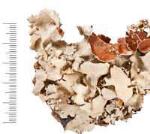
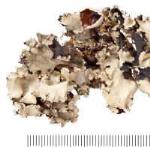
Parmotrema abessinicum
(Kremp.) Hale, Phytologia 28: 334
(1974).
Description:
Thallus loosely adnate, 4–7 cm wide; lobes up
to 1 cm wide, margins ascending, ciliate; upper surface pale
grey, maculate, strongly rugose in older parts; medulla white;
lower surface black to pale brown at margins, with broad,
sparsely rhizinate margin. Cortex K+ yellow; atranorin.
Medulla K-, C-, KC+ purple, P-; norlobaridone and
accessories, and fatty acids. Distinguished by the absence of
soredia and isidia and by the KC+ purple (norlobaridone)
reaction in the medulla.
Ecology and distribution:
Corticolous in a dry dipterocarp forest in Lamphun Province,
Doi Khun Tan National Park; also reported from Chiang Mai
by POOPRANG et al. (1999). Rare in India (DIVAKAR &
UPRETI 2005), occurring in S America, SW Africa (HALE
1965) and E Africa (SWINSCOW & KROG 1981).
40
Medulla UV+ blue-white (alectoronic,
α
–collatolic)
41
41
Upper surface strongly white-maculate. Thallus often blackened
Parmotrema nilgherrense (Nyl.) Hale
Parmotrema nilgherrense
(Nyl.) Hale, Phytologia 28 :338
(1974).
Syn.:
Parmelia nilgherrensis
Nyl., Flora, Jena 52: 291
(1869).
Description:
Thallus loosely adnate, to 10 cm wide;
lobes 4–8 mm wide with ascending margins, cilia 2–3 mm
long; upper surface pale grey to greenish grey, white–
maculate, often blackened, lacking isidia and soredia; lower
surface black with brown margin; rhizines sparse to dense.
Cortex K+ yellow; atranorin. Medulla K–, C–, KC+ red, P-,
UV+ blue-white; alectoronic and
α
–collatolic acids.
Distinguished from other alectoronic/
α
–collatolic acid
containing species without vegetative propagules by the
distinctly maculate upper cortex.
P. poolii
has marginal
soredia and a rather flatter thallus.
Ecology and
distribution:
Corticolous in evergreen forest at 2565 m,
savanna (at edge of moss forest) 2000–2590 m and alpine
meadow at 2500 m. Also in dry dipterocarp forests where it is
frequent, c. 900 m. Reported from Africa, Asia (KROG &
SWINSCOW 1981; DIVAKAR & UPRETI 2005) including
Papua New Guinea (LOUWHOFF & ELIX 1999) and Islas
Juan Fernández (ELIX & McCARTHY 2008).
41
Upper surface emaculate or only faintly maculate.
Thallus rarely blackened
42
42
Thallus membranaceous to coriaceous. Spores 29-35
µ
m long. Conidia filiform
Parmotrema corniculans (Nyl.) Hale
Parmotrema corniculans
(Nyl.) Hale, Phytologia 28(4): 335
(1974).
Syn.:
Parmelia corniculans
Nyl., Flora, 68: 607 (1885).
Description:
Thallus loosely adnate 5-10 cm wide; lobes up
to 0.8-2 cm wide, margins ascending, ciliate; upper surface
pale grey, emaculate, cracked towards centre; medulla white
throughout or with a yellow pigment in the lower part; lower
surface black to pale brown at margins, with broad, sparsely
rhizinate margins. Apothecia 3-10 mm wide, the exciple
dentate. Cortex K+ yellow; atranorin. Medulla K-, C-, KC+
red, P-, UV+ blue-white (pigmented medulla K+ red);
alectoronic and
α
–collatolic acids.
Ecology and
distribution:
Reported from Chiang Mai Province, Doi
Inthanon National Park, corticolous in an evergreen forest at
2000 m by POOPRANG et al. (1999); we have not examined
the specimen. This is a south-east Asian species, also