Basic HTML Version


35
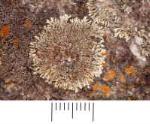
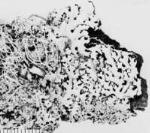
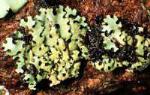
Xanthoparmelia mougeotina
(Nyl.) D.J. Galloway, New
Zealand J. Bot. 18: 538 (1981).
Description:
Thallus foliose to subcrustose and tightly
adnate, 3–5 cm wide, lobes sublinear–elongate, 0.5–1 mm
wide; upper surface pale yellow–green, darkening and
becoming cracked–areolate centrally, sparsely isidiate with
slender or slightly inflated isidia; lower surface black to
dark–brown and sparsely rhizinate. Cortex K–; usnic acid.
Medullla K+ yellow, C–, KC–, P+ orange; stictic, constictic
and norstictic acids.
X. congensis
is distinguished by the
eroded isidia.
Ecology and distribution:
Saxicolous in an
evergreen forest, Lamphun Province, Doi Khun Tan National
Park, 900 m. Reported from Australia, New Zealand and
Papua New Guinea (ELIX 1994h)
78
Lobes with marginal black cilia which are swollen at the base
Relicina planiuscula (Kurok.) Hale
Relicina planiuscula
(Kurok.) Hale, 1974, Phytologia 28:
484.
Syn.:
Parmelia planiuscula
Kurokawa in Hale and
Kurokawa, 1964, Contr. US Natn. Herbarium 36.
Description:
Thallus adnate on bark, coriaceous, 5-9 cm
diam.; lobes sublinear-elongate, 1-3 mm wide; upper surface
plane, faintly maculate, sparsely to moderately isidiate, the
isidia simple, > 0.7 mm high, frequently procumbent, rarely
lobulate; lower surface black, moderately rhizinate, the
rhizines simple, black. Apothecia rare, adnate, 1-2 mm diam.,
ecoronate, the amphithecium isidiate. Upper cortex K-; usnic
acid. Medulla K+ yellowish, C+ faint yellow-orange, KC-,
P+ yellow; echinocarpic and usnic acids and a C+ unknown.
Ecology and distribution:
This is the commonest species of
Relicina at higher elevations in Southeast Asia, on trunk and
branches of
Quercus
and other trees in open forests and
mossy forest at 1500-2200 m. Reported from Chiang Mai
Prov., Mushroom Research Centre along road to Pae, 750-
800 m. Also known from Japan, Taiwan, Philippines,
Malaya, Indonesia, and Sabah (HALE 1975b).
78
Lobes without cilia
79
79
Medulla KC+ yellow (barbatic)
Relicinopsis rahengensis (Vain.) Elix & Verdon
Relicinopsis rahengensis
(Vain.) Elix & Verdon, Mycotaxon
27: 282 (1986).
Syn.:
Parmelia rahengensis
Vain., Ann. Soc. Zool.–Bot.
Fenn. Vanamo, 1: 39 (1921).
Description:
Thallus adnate, 3–
6 cm, lobes 0.5–1.5 mm wide, with eciliate margins; upper
surface yellow green with dense, simple or branched isidia,
mainly in the older part; lower surface pale to dark brown
with dense, mainly simple to sparsely branched rhizines.
Cortex K–; usnic acid. Medulla K–, C–, KC+ yellow, P– or
P+ pale orange; barbatic acid. 4–O–demethylbarbatic acid
(minor), ± echinocarpic acid (minor).
Ecology and
distribution:
Corticolous in dry dipterocarp forest and mixed
deciduous forest at 600–900 m, and in montane oak/chestnut
forest to 1550 m. Also reported from Australia where it is
rare (ELIX 1994f).
79
Medulla KC- (protocetraric)
Relicinopsis malaccensis (Nyl.) Elix & Verdon