Basic HTML Version


34
species.
P. nilgherrense
is white–maculate and lacks soredia,
P. subarnoldii
has an uneven and foveolate thallus and
protocetraric acid (P+ orange–red) and
P. rampoddense
has
longer cilia (3–6 mm) and a K+ purple pigmented lower
medulla.
Ecology and distribution:
Corticolous in evergreen
forests at 700–900 m in Chiang Mai Province, Doi Inthanon
National Park, and in Mae Hong Son Province, Mae Lao–
Mae Sae Wildlife Sanctuary. Reported from Australia, E
Africa, Thailand, Madagascar (ELIX 1994e; KROG &
SWINSCOW 1981), Papua New Guinea (LOUWHOFF &
ELIX 1999) and Hawai’i (LOUWHOFF 2000).
74
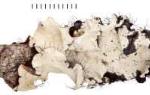
Cilia 3-6 mm long. Medulla pigmented in lower layers. Lobes 5-15 mm wide
Parmotrema rampoddense (Nyl.) Hale
Parmotrema rampoddense
(Nyl.) Hale, Phytologia 28: 338
(1974).
Syn.:
Parmelia rampoddensis
Nyl., Acta Soc. Sci. Fenn. 26:
7 (1900).
Description:
Thallus up to 15 cm wide, loosely
adnate, lobes irregular, 6–15 mm wide, margins incised with
dense, 3–6 mm long, simple to furcated cilia; upper surface
pale grey to grey with linear or occasionally subcapitate
soralia; medulla white, partly pigmented K+ purple; lower
surface black with brown margin, rhizines sparse, simple.
Cortex K+ yellow; atranorin. Medulla K–, C–, KC+ red, P–,
UV+ blue-white; alectoronic &
α
–collatolic acids, ± skyrin.
For distinction from other alectoronic/
α
–collatolic acid
containing species with marginal soredia see under
P. poolii
.
P. subarnoldii
has longer rhizines and contains protocetraric
acid.
Ecology and distribution:
Corticolous in mixed
deciduous forest at 800 m in Lampang Province, Wiang
Kosai National Park and in Chiang Mai Province, Doi Suthep
National Park, 840 m. Pantropical (ELIX 1994e).
75
Upper cortex K- (usnic acid)
76
75
Upper cortex K+ yellow (atranorin)
80
76
On rock
77
76
On bark or wood
78
77
Isidia epicorticate, eroding
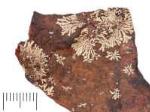
Xanthoparmelia congensis (Stein) Hale
Xanthoparmelia congensis
(Stein) Hale, Phytologia 28: 486
(1974).
Syn.:
Parmelia congensis
Stein., Jahresber. Schles. Ges.
Vartel. Cult. 66: 140 (1889).
Description:
Thallus
subcrustose and very tightly adnate, 2–4 cm wide, lobes
sublinear 0.3–0.9 mm wide; upper surface pale yellow–green,
becoming areolate, with epicorticate and eroding isidia; lower
surface black and sparsely rhizinate. Cortex K–; usnic acid.
Medulla K+ yellow, C–, KC–, P+ orange; stictic acid.
Separated from
X. mougeotina
by the eroding isidia.
Ecology
and distribution:
Saxicolous, found between 500 and 1065
m in Phitsanulok Province, Nakorn Thai district, and in
Chiang Mai Province, Doi Saget District. Reported from
India, China (incl. Hong Kong), Australia, America, Africa
(DIVAKAR & UPRETI 2005) and Thailand (POOPRANG et
al. 1999).
77
Isidia slender to slightly inflated, not eroded
Xanthoparmelia mougeotina (Nyl.) D.J. Galloway