Basic HTML Version


33
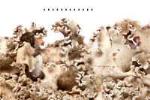
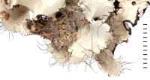
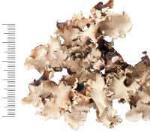
Parmotrema hababianum
(Gyelnik) Hale, Phytologia 28:
339 (1974).
Description:
Thallus loosely attached, 8–10 cm wide, lobes
rounded, 5–15 mm wide, with sparsely ciliate (cilia 0.5–2.0
mm long), subascending margins; upper surface and ±
maculate and mineral to grey–green with marginal and
submarginal, linear or capitate soralia; lower surface black
with white or mottled marginal zone. Cortex K+ yellow;
atranorin. Medulla K–, C–, KC+ reddish, P–, UV-;
protolichesterinic acid.
P. rampoddense
is emaculate and has
alectoronic instead of protolichesterinic acid.
P.
praesorediosum
lacks marginal cilia and has all medullary
spot tests negative and fatty acids.
Ecology and
distribution:
Corticolous in a plantation forest in Chiang
Mai Province, Doi Suthep National Park, at 1400 m
(POOPRANG et al. 1999). Reported from N and S America,
Africa (SWINSCOW & KROG 1988), India (DIVAKAR &
UPRETI 2005), Thailand, China, Sri Lanka (WOLSELEY et
al. 2002) and Nepal (KUROKAWA 1993).
72
Lobes with dense marginal cilia. Medulla with
alectoronic/
α
–collatolic acids, UV+ blue-white
73
73
Upper surface strongly white-maculate. Medulla (fleeting) C+ red
Parmotrema lobulascens (J.Steiner) Hale
Parmotrema lobulascens
(J.Steiner) Hale, Phytologia 28:
337 (1974).
Syn.:
Parmelia lobulascens
J. Steiner Verh. Zool. Bot. Ges.
Wien 53: 234 (1903).
Description:
Thallus loosely adnate,
lobes 4–6 mm wide, with commonly lobulate margins tinged
brown with conspicuous, up to 2 mm long cilia; upper
surface greenish grey, ± maculate; soralia linear on ascending
lobe margins; lower surface black with pale brown to
yellowish marginal zone; rhizines simple, scattered. Cortex
K+ yellow; atranorin. Medulla K–, C+ pink, KC+ purple, P-,
UV+ blue-white; alectoronic and
α
–collatolic acids, ±
gyrophoric acid. Distinguished from
P. nilgherrense
by the
presence of soralia. The thai specimen has 4–6 mm wide
lobes, while SWINSCOW & KROG (1988) report 0.5–20
mm wide lobes.
Ecology and distribution:
Known from a
single locality in northern Thailand: corticolous in a
relatively disturbed evergreen forest at 1100 m in Chiang Rai
Province, Khun Lao Village; more frequent in Uthai Thani
and other areas to the south. Reported from Africa and Asia
(SWINSCOW & KROG 1988) and Australia (McCARTHY
2008).
73
Upper surface emaculate or faintly maculate.
Medulla C-
74
74
Cilia to 3 mm long. Medulla white throughout. Lobes 10-20 mm wide
Parmotrema poolii (C.W. Dodge) Krog & Swinscow
Parmotrema poolii
(C.W. Dodge) Krog & Swinscow,
Lichenologist 15: 130 (1983).
Syn.:
Parmelia poolii
C.W. Dodge, Ann. Mo. Bot. Gdn.
46:146 (1959).
Description:
Thallus loosely adnate, 10–20
cm wide; lobes irregular and rounded, 5–10 mm wide with
sparse to dense, 0.3–4 mm long cilia; upper surface grey to
grey–green and becoming finely cracked with marginal
soredia; lower surface black with brown margin; rhizines
scattered, to 2 mm long. Cortex K+ yellow; atranorin.
Medulla K–, C–, KC+ red, P–, UV+ blue-white; alectoronic
&
α
–collatolic acids. The presence of soredia distinguish this
species from other alectoronic/
α
–collatolic acid containing