Basic HTML Version


32
also C+ red but has gyrophoric instead of lecanoric acid and
farinose rather than granular soredia.
Ecology and
distribution:
Corticolous in a mixed deciduous forest at 800
m. Reported from Australia, Africa, Asia (ELIX 1994) India
(DIVAKAR & UPRETI 2005), and Papua New Guinea
(LOUWHOFF & ELIX 1999).
70
Medulla KC-
Parmotrema praesorediosum (Nyl.) Hale
Parmotrema praesorediosum
(Nyl.) Hale, Phytologia 28:
338 (1974).
Syn.:
Parmelia praesorediosa
Nyl., Sert. Lich. Trop. Labuan
Singapore: 18 (1891).
Description:
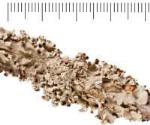
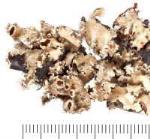
Thallus adnate, up to 8
cm wide, lobes rounded, 4–7 mm wide with eciliate,
suberect, sorediate margins; upper surface pale grey, fragile
and cracked in older parts, soredia granular; lower surface
black with mottled, narrow (1–2 mm wide) margin; rhizines
sparse, simple, short (1–2 mm long). Cortex K+ yellow;
atranorin. Medulla K-, C- KC- P-; protopraesorediosic and
praesorediosic acids. Distinguished by negative spot tests on
the medulla, the presence of fatty acids, and from
P.
hababianum
by the emaculate upper surface.
Ecology and
distribution:
Corticolous in deciduous dipterocarp forests
from 420 to 840 m (Lampang Province, Wiang Kosai
National Park, and Chiang Mai Province, Doi Suthep
National Park). Also known to occur on rock (ELIX 1994e;
DIVAKAR & UPRETI 2005). Pantropical.
70
Medulla KC+ (fleeting) red
71
71
Thallus with isidioid marginal outgrowths which become sorediate
Parmotrema mellissii (C.W.Dodge) Hale
Parmotrema mellissii
(C.W.Dodge) Hale, Phytologia 28: 337
(1974).
Syn.:
Parmelia mellissii
C.W.Dodge, Ann. Missouri Bot.
Gard. 46: 134 (1959).
Description:
Thallus loosely attached,
up to 12 cm wide, lobes 2–8 mm wide with ascending,
crenate margins with abundant cilia which are 2–4 mm long;
upper surface pale grey to grey–green, emaculate, with
abundant marginal soralia intermixed with marginal and
submarginal isidioid outgrowths that become sorediate;
medulla white; lower surface black with dark brown marginal
zone; rhizines long, slender, in scattered groups. Cortex K+
yellow; atranorin. Medulla K–, C–, KC+ reddish, P–, UV+
blue-white; alectoronic acid,
α
–collatolic acid. Distinguished
from other species with alectoronic and/or
α
–collatolic acids
by the ciliate isidioid marginal outgrowths that become
sorediate. Skyrin reported but not seen in Thai specimens.
Ecology and distribution:
Corticolous in evergreen forest at
960 and 1600 m (Chiang Mai Province: Doi Suthep and Doi
Inthanon National Parks). Corticolous and saxicolous in India
(DIVAKAR & UPRETI 2005). Widespread in tropical and
warm temperate regions (SWINSCOW & KROG 1988).
71
Thallus without isidioid marginal outgrowths
72
72
Lobes with sparse marginal cilia. Medulla with protolichesterinic acid, UV-
Parmotrema hababianum (Gyelnik) Hale