Basic HTML Version


31
National Park). Widely distributed in tropical–subtropical
regions of the world (DIVAKAR & UPRETI 2005).
66
Soralia marginal, not pustulate
67
67
Medulla C+ red
68
67
Medulla C-
70
68
Medulla white in upper part and yellowish below
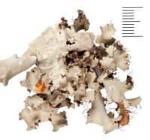
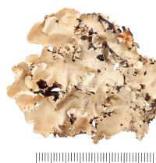
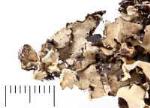
Parmotrema permutatum (Stirton) Hale
Parmotrema permutatum
(Stirton) Hale, Phytologia 28: 338
(1974).
Syn.:
Parmelia permutata
Stirton, Scott. Nat. 4: 252 (1877–
8).
Description:
Thallus loosely attached and overlapping, to
5 cm wide, lobes rounded, up to 1 cm wide with margins
entire to crenate and dense, cilia 2–4 mm long; upper surface
mineral grey, smooth, emaculate with sorediate margins
giving edges a crinkled appearance; medulla white in upper
part and yellowish below; lower surface black with dark
brown shining marginal zone, rhizines sparse. Cortex K+
yellow; atranorin. Medulla K–, C+ red, KC+ pale red, P–;
gyrophoric acid and unidentified pigment (HALE 1965).
Distinguished from other gyrophoric acid containing species
by the partly ochraceous medulla.
Ecology and distribution:
Corticolous in an evergreen forest at 700–800 m in Chiang
Rai Province, Khun Lao Village. Reported from southern and
eastern Africa, India, Sumatra, Papua New Guinea, Haiti and
Brazil (ELIX 1994e).
68
Medulla white throughout
69
69
Soredia farinose. Medulla with gyrophoric acid
Parmotrema sancti–angelii (Lynge) Hale
Parmotrema sancti–angelii
(Lynge) Hale, Phytologia 28:
339 (1974).
Syn.:
Parmelia sancti–angelii
Lynge, Ark. Bot. 13 (13): 35
(1914).
Description:
Thallus up to 15 cm wide, loosely
attached, lobes irregular, 7–14 mm wide, with crenate to
incised, sparsely to densely ciliate margins; upper surface
grey green with marginal soralia (soredia farinose); lower
surface black with brown margin; rhizines dense, simple.
Upper cortex K+ yellow; atranorin. Medulla K–, C+ red,
KC+ red, P–; gyrophoric acid. This species can be difficult to
separate from
P. cooperi
which is also C+ red but has
lecanoric instead of gyrophoric acid and granular rather than
farinose soredia.
Ecology and distribution:
Corticolous in
dry dipterocarp, mixed deciduous and evergreen forests
between 900 and 1460 m. Pantropical.
69
Soredia granular. Medulla with lecanoric acid
Parmotrema cooperi (J.Steiner & Zahlbr.) Sérus.
Parmotrema cooperi
(J.Steiner & Zahlbr.) Sérus., Bryologist
87: 4 (1984).
Syn.:
Parmelia cooperi
J.Steiner & Zahlbr., in Zahlbr., Bot.
Jb. 60: 528 (1926).
Description:
Thallus loosely adnate, 7–
15 cm wide with densely ciliate (cilia 2–5 mm long),
rounded, 7–15 mm wide lobes; upper surface grey to grey–
green and irregularly cracked with marginal and submarginal,
granular soralia; lower surface black with brown margin and
sparse, simple, short (2 mm long) rhizines. Cortex K+
yellow; atranorin. Medulla K–, C+ red, KC+ red, P–;
lecanoric acid.
P. subarnoldii
is P+ orange (protocetraric
acid), has farinose soredia, longer rhizines and may have a
mottled marginal zone on lower surface.
P. sancti–angelii
is