Basic HTML Version


30
65
Upper surface yellowish (usnic). Medulla with a yellowish pigment below the upper
cortex
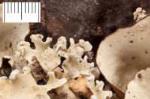
Parmotrema dilatatum (Vain.) Hale
Parmotrema dilatatum
(Vain.) Hale, Phytologia 28: 335
(1974).
Syn.:
Parmelia dilatata
Vain., Acta Soc. Fauna Flora fenn.
7(7): 32 (1890).
Description:
Thallus loosely attached, 3–
10(–15) cm wide, with rounded, eciliate lobes 8–13 mm
wide; upper surface yellowish grey, soralia marginal and
linear, or subcapitate on ascending lateral lobes; medulla
white with yellowish pigment in layer below cortex; lower
surface black with paler marginal zone; rhizines sparse.
Cortex K+ yellow; atranorin and usnic acid. Medulla K+
dirty yellow-brown, C–, KC-, P+ orange-red; protocetraric
acid (major). Distinguished by the usnic acid in the cortex
and pigmentin upper layers of medulla.
Ecology and
distribution:
Corticolous in disturbed evergreen forests
above 1000 m and mixed deciduous forests at 800 m (Chiang
Mai Province, Doi Suthep National Park; Chiang Rai
Province, Khun Lao Village). Reported from Africa, Asia, S
America (SWINSCOW & KROG 1988), India (DIVAKAR
& UPRETI 2005), the Pacific (ELIX & McCARTHY 2008),
Australia and New Zealand (ELIX 1994e).
65
Upper surface grey-green. Medulla white throughout
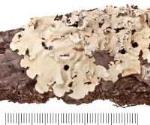
Parmotrema gardneri (C.W. Dodge) Sérus.
Parmotrema gardneri
(C.W. Dodge) Sérus., Bryologist 87: 5
(1984).
Syn.:
Parmelia gardneri
C.W. Dodge, Ann. Mo. Bot. Gdn
46: 179 (1959).
Description:
Thallus loosely attached to
adnate, 4–6 cm wide, lobes overlapping, 7–16 mm wide, with
subascending and irregularly incised, eciliate or sparsely
ciliate margins; upper surface pale to green–grey, with
marginal and linear to subcapitate soralia; lower surface
black with a brown zone and simple, sparse, slender, short
(0.1–0.2 mm long) rhizines. Cortex K+ yellow; atranorin.
Medulla K+ dirty yellow, C–, P+ orange-red; protocetraric
acid. Distinguished from
P. dilatatum
by the absence of usnic
acid.
Ecology and distribution:
Corticolous on twigs,
branches and trunks, common in dry dipterocarp forests
between 700 and 900 m, and in disturbed evergreen forests at
1100 m. Pantropical, reported from Australia, Africa, South
America, Papua New Guinea and the Pacific (ELIX 1994e,
ELIX & McCARTHY 2008, LOUWHOFF & ELIX 1999).
66
Soralia laminal, initially somewhat pustulate
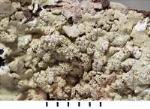
Canoparmelia texana (Tuck.) Elix & Hale
Canoparmelia texana
(Tuck.) Elix & Hale, Mycotaxon 27:
279 (1986).
Syn.:
Parmelia texana
Tuck., American Journal of Science &
Arts, ser. 2 25: 424 (1858).
Description:
Thallus adnate, 6–
12 cm wide, lobes (1–)3–5 mm wide, eciliate; upper surface
grey–white or yellowish–white with laminal, initially
somewhat pustulate soralia; lower surface black with brown
erhizinae zone, rhizines simple, sparse, black. Cortex K+
yellow; atranorin. Medulla K–, C–, KC– or + faint pink, P–,
UV+ white; divaricatic acid. Distinguished from
C.
owariensis
by the sorediate upper surface.
Ecology and
distribution:
Corticolous in northern Thailand and
infrequent on dry bark of
Pinus kesyia
and
Dipterocarpus
obtusifolius
at 640–1000 m (Chiang Mai Province, Doi
Suthep National Park and Lampang Province, Doi Khun Tan