Basic HTML Version


29
subcaperatum, P. subsumptum
and
P. subtinctorium
, these
formerly in
Rimelia
and
Canomaculina
) by the naked
marginal zone on the lower surface and the emaculate thallus.
P. cristiferum
rarely produces rudimentary cilia in the lobe
axils but their presence seems to be of limited taxonomic
significance (KROG & SWINSCOW 1981; LOUWHOFF &
ELIX 1999).
Ecology and distribution:
Corticolous in dry
evergreen forests, mixed deciduous forests and seasonal
rainforests between 370 and 1200 m. Widespread throughout
tropical and subtropical areas (ELIX 1994; HALE 1965;
LOUWHOFF & ELIX 1999) but rare in Africa (KROG &
SWINSCOW 1981).
62
Medulla P+ orange to red
63
62
Medulla P-
66
63
Medulla K+ bright yellow (stictic)
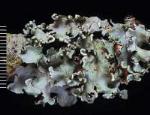
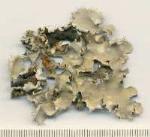
Parmotrema perlatum (Huds.) M. Choisy
Parmotrema perlatum
(Huds.) M. Choisy, Bull. Mens. Soc.
Linn. Soc. Bot. Lyon 21: 174 (1952).
Syn.:
Parmotrema chinense
(Osbeck) Hale & Ahti, Taxon
35: 133 (1986);
Lichen perlatus
Huds., Flora Anglica: 448,
1762.
Description:
Thallus loosely adnate, 5–7 cm wide,
lobes 7–15 mm wide, with sparse cilia and adscending
margins; upper surface silver grey to grey–green, cracked in
older parts, with marginal soredia (soralia granular); lower
surface black with brown margin; rhizines moderately dense,
simple, short. Cortex K+ yellow; atranorin. Medulla K+
bright yellow, C–, KC–, P+ orange; stictic and constictic
acids and traces of related compounds.
P. cristiferum
has
salazinic acid and
P. gardneri
has protocetraric acid, and
soralia forming complex raised structures on narrow, lateral
lobes.
Ecology and distribution:
Corticolous in evergreen
forests above 1000 m. A pantemperate to tropical species,
widespread in the Northern and Southern Hemispheres.
63
Medulla K- (or K+ dirty yellow-brown),
(protocetraric)
64
64
Cilia conspicuous, more or less dense, > 2 mm long
Parmotrema subarnoldii (Abbayes) Hale
Parmotrema subarnoldii
(Abbayes) Hale, Phytologia 28:
339 (1974).
Syn.:
Parmelia subarnoldii
Abbayes, Mém. Inst.sci.
Madagascar B, 10: 113 (1961).
Description:
Thallus loosely
adnate, 5–15 cm wide, lobes rounded or incised, 9–14 mm
wide, margins with dense, 2–6 mm long, simple or
bifurnicate cilia; upper surface pale grey to green grey, often
uneven and foveolate with ascending marginal soredia;
medulla white ± pigment; lower surface dark with a brown or
mottled margin; rhizines sparse, long, simple or rarely
branched. Upper surface K+ yellow; atranorin. Medulla K–
or K+ dirty brown, C–, KC+ red–brown, P+ orange–red;
protocetraric and protolichesterinic acids, ± skyrin.
Distinguished from
P. gardneri
, which also has protocetraric
acid in the medulla, by the conspicuous cilia which are well
developed.
Ecology and distribution:
Corticolous in a
mixed deciduous forest at 800 m in Mae Hong Son Province,
Mae Lao–Mae Sae Wildlife Sanctuary; also reported by
POOPRANG et al. (1999). Pantropical (ELIX 1994).
64
Cilia sparse, sometimes restricted to lobe axils and
damaged margins only, to 1.5 mm long
65