Basic HTML Version


28
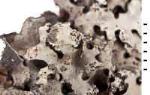
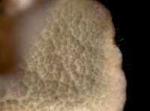
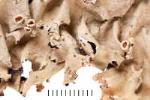
Hypotrachyna exsecta
(Taylor) Hale, Phytologia 28: 341
(1974).
Syn.:
Parmelia exsecta
Taylor, London J. Bot. 6: 167 (1847).
Description:
Thallus 5–13 cm wide with lobes 1–3 mm,
often crowded, with pustules subterminal or occasionally
laminal, sometimes tall and open, mostly erumpent,
eventually eroding and becoming coarsely granular–
sorediate; lower surface black with densely branched rhizines
that frequently project beyond lobe margins. Cortex K+
yellow; atranorin. Medulla K–, C+ orange, KC+ deep orange,
P–; barbatic and 4–O–demethylbarbatic acids. Distinguished
from
H. adjuncta
by the lack of echinocarpic acid.
H.
laevigata
is distinguished by the presence of simple soralia
with farinose soredia, the absence of pustules and broader
lobes (2–5 vs. 1–3 mm wide).
Ecology and distribution:
It
was found in a montane 'moss forest' and a
Lithocarpus/Castanopsis
forest, at 1000–2000 m (Chiang
Mai Province, Doi Inthanon, Queen’s stupa forest, and
Lampang Province, Doi Khun Tan National Park). Reported
from Australia, SE Asia, E Asia and the Pacific (ELIX
1994d, 2001; KUROKAWA & LAI 2001; POOPRANG et al.
1999) and Papua New Guinea (KASHIWADANI 1975;
KUROKAWA 1979; LOUWHOFF & ELIX 2002).
60
Medulla K+ yellow turning red (salazinic)
61
60
Medulla K- or K+ yellow
62
61
Upper surface maculate and cracked
Parmotrema reticulatum (Taylor) M. Choisy
Parmotrema reticulatum
(Taylor) M. Choisy, Bull. Mens.
Soc. Linn. Soc. Bot. Lyon. 21: 175 (1952).
Syn.:
Rimelia reticulata
(Taylor) Hale & A. Fletcher,
Bryologist 93: 28 (1990),
Parmelia reticulata
Taylor in J.
Mackay, Fl. Hibern., 2: 148, 1836.
Description:
Thallus
loosely adnate, 5–20 cm wide; lobes subrotund to
subirregular, 4–15 mm wide, margins irregularly–incised to
laciniate–dissected with cilia to 1 mm long; upper surface
pale grey–green, distinctly maculate to cracked with
marginal, subcapitate to linear soralia; lower surface dark
brown to black with dense, simple or squarrose rhizines.
Cortex K+ yellow; atranorin. Medulla K+ yellow turning red,
C–, KC-, P+ orange; salazinic acid. Distinguished from other
maculate species with salazinic acid by the marginal soralia
and from
P. subsumptum
which has a closely adnate thallus.
This species is extremely variable, readily separated from
P.
cetratum
by the marginal soralia.
Ecology and distribution:
Corticolous throughout undisturbed and disturbed forests
between 800 and 1450 m. Cosmopolitan.
61
Upper surface not maculate and cracked
Parmotrema cristiferum (Taylor) Hale
Parmotrema cristiferum
(Taylor) Hale, Phytologia 28: 335
(1974).
Syn.:
Parmelia cristifera
Taylor, J. Bot., Lond. 6: 165
(1847).
Description:
Thallus loosely attached, 3–10(–15) cm
wide with lobes often overlapping, 6–20 mm wide and
margins ascending and eciliate; upper surface mineral to pale
greenish–grey with marginal to submarginal granular soralia;
lower surface black with pale brown to tan marginal zone and
sparse, short (0.1–0.2 mm long) rhizines. Cortex K+ yellow;
atranorin. Medulla K+ yellow turning red, C–, KC-, P+
orange; salazinic acid and consalazinic acid. Distinguished
from other species with salazinic acid (
P. reticulatum, P.