Basic HTML Version


27
and distribution:
An endemic, corticolous species of
northern Thailand, found on
Pinus
sp. along a road at 2450 m
in Chiang Mai Province, Chom Thong District, Doi Inthanon.
58
Medulla C-, KC+ rose. Soredia not arising from pustules
Hypotrachyna immaculata (Kurok.) Hale
Hypotrachyna immaculata
(Kurok.) Hale, Smithsonian
Contr. Bot. 25: 41 (1975).
Syn.:
Parmelia immaculata
Kurok., in M.E.Hale &
S.Kurokawa, Contr. U.S. Natl Herb. 36: 178 (1964).
Description:
Thallus loosely to tightly adnate, up to 5(–7)
cm wide, with contiguous, sublinear, 1.5–3 mm wide lobes
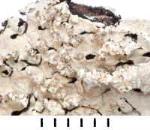
with incised apices; upper surface whitish grey with large (1–
2 mm wide), capitate soralia; medulla mostly white, orange–
brown below soralia; lower surface with dense, dichotomous
rhizines. Cortex K+ yellow; atranorin. Medulla K– or K+
pale reddish, C–, KC+ rose, P–, UV–; 4–O–methylphysodic
acid (major), lividic acid (minor), colensoic acid (minor),
physodic acid (minor) and related traces. Distinguished from
H. osseoalba
by having capitate rather than pustulate soralia
and the absence of lichexanthone (UV–). It is separated from
all other
Hypotrachyna
species in northern Thailand by the
distinctive chemistry.
Ecology and distribution:
Corticolous
in an oak/pine forest at c. 1000 m in Chiang Mai Province,
Mae Soi valley ridges. Reported from Australia, South
America, Africa (ELIX 1994d) and Asia (WOLSELEY et al.
2002).
58
Medulla C+ orange, KC+ deep orange (barbatic).
Soredia arising from pustules
59
59
Pustules eroding to expose black lower cortex. Echinocarpic acid present
Hypotrachyna adjuncta (Hale) Hale
Hypotrachyna adjuncta
(Hale) Hale, Phytologia 28: 340
(1974).
Syn.:
Parmelia adjuncta
Hale, Phytologia 22(6): 434 (1972).
Description:
Thallus loosely overlapping to 10 cm wide,
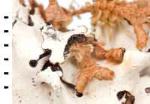
with sublinear to subirregular lobes; upper surface mineral to
grey–green with subcapitate pustules that often become
erumpent and then coarsely granular–sorediate, eventually
eroding and exposing black lower cortex; lower surface dark
brown to black, rhizines dense, dischotomously branched and
projecting beyond margins. Cortex K+ yellow; atranorin and
chloroatranorin; medulla K–, C+ orange, KC+ dark orange,
P–; barbatic, 4–O–demethylbarbatic, obtusatic, norobtusatic
and echinocarpic acids.
H. exsecta
is morphologically and
chemically similar but separated by the lack of echinocarpic
acid.
Ecology and distribution:
found in a montane
oak/chestnut forest at 1500–1600 m in Chiang Mai Province,
Doi Suthep National Park. Reported from India, West
Malaysia, Sabah, the Philippines, Taiwan, Japan (HALE
1972), Thailand (POOPRANG et al. 1999), Australia (ELIX
2001a) and Papua New Guinea (LOUWHOFF & ELIX
2002).
59
Pustules erumpent, not eroding to expose black lower cortex. Echinocarpic acid
absent
Hypotrachyna exsecta (Taylor) Hale