Basic HTML Version


26
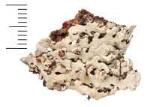
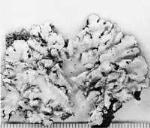
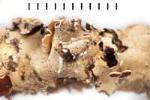
Hypotrachyna osseoalba
(Vain.) Y.S. Park & Hale, Taxon
38: 88 (1989).
Syn.:
Parmelia formosana
Zahlbr., Repert Spec. Nov. Regni
Veg. 33: 57 (1934).
Description:
Thallus 3–8 cm wide,
moderately to tightly adnate, lobes subcontiguous to
imbricate, (1-)2-3 mm wide; upper surface mineral grey–
green with laminal to submarginal sorediate pustules and
open dactyls; lower surface moderately to densely rhizinate;
rhizines densely dichotomously branched and projecting
beyond lobe margin. Cortex K–, UV+ yellow; lichexanthone
(major), atranorin (minor). Medulla K+ dirty brown, C–, P–
or P+ pale orange; lividic acid (major), colensoic acid
(minor) and related compounds, ±pigmentosin B (trace). This
species is readily distinguished by the UV+ yellow upper
surface (lichexanthone) and pustules.
H. exsecta
and
H.
adjuncta
also produce pustules, but they lack lichexanthone.
Ecology and distribution:
Frequent in montane oak/chestnut
and evergreen forests between 960 and 1600 m. Common in
Thailand, occurring both in subtropical and temperate regions
(ELIX 1994d; KUROKAWA & LAI 2001, LOUWHOFF &
ELIX 2002).
55
Soralia capitate on lobe ends. Upper surface UV-
56
56
Medulla K+ red or K+ yellow turning red
57
56
Medulla K-
58
57
Thallus dull, often pruinose. Medulla with salazinic acid
Hypotrachyna brevirhiza (Kurok.) Hale
Hypotrachyna brevirhiza
(Kurok.) Hale, Smithsonian Contr.
Bot. 25: 26 (1975).
Syn.:
Parmelia brevirhiza
Kurok., in M. E.Hale & S.
Kurokawa, Contr. U. S. Natl Herb. 36: 166 (1964).
Description:
Thallus ± adnate to 8 cm wide, frequently
pruinose, with sublinear to subirregular lobes that are
contiguous or overlapping, with subcapitate soralia and
soredia that are initially farinose, becoming granular and
clustered; lower surface black, densely rhizinate with a
narrow erhizinate margin. Cortex K+ yellow; atranorin.
Medulla K+ yellow then dark red, C–, KC-, P+ orange;
salazinic. This species is the only sorediate, salazinic acid
producing
Hypotrachyna
in northern Thailand.
Ecology and
distribution:
The first record for Thailand, occurring on
Shorea obtusa
in a dry dipterocarp forest at 900 m in the
Chiang Mai Province, Doi Inthanon National Park. A
pantropical species, reported from South America, Indonesia
(HALE & KUROKAWA 1964; HALE 1975), India
(DIVAKAR & UPRETI 2005), Africa (SWINSCOW &
KROG 1988), Australia (ELIX 1994d), Macquarie Island
(FILSON 1981), the Pacific (ELIX & McCARTHY 2008)
and Papua New Guinea (APTROOT & SIPMAN 1991;
LOUWHOFF & ELIX 2002).
57
Thallus glossy. Medulla with norstictic acid
Hypotrachyna granulans K.H. Moon & Kurok.
Hypotrachyna granulans
K.H. Moon & Kurok., Bull. Natn.
Sci. Mus., Tokyo, Ser.B, 26: 135 (2000).
Description:
Thallus 2–6 cm wide, loosely adnate with lobes
2–4 mm wide, emaculate, shiny with marginal to capitate
soredia; lower surface brown to black, shortly rhizinate with
erhizinate zone near lobe tips. Cortex K+ yellow; atranorin.
Medulla K+ yellow turning red; norstictic acid (major). It
differs from
H. kingii
, which also contains norstictic acid, in
the non-flaking cortex and the absence of pustules.
Ecology