Basic HTML Version


44
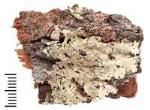
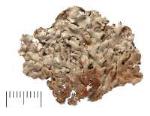
Canoparmelia ecaperata
(Mull.Arg.) Elix & Hale,
Mycotaxon 27: 278 (1986).
Syn.:
Parmelia ecaperata
Müll. Arg., Flora, Jena 74: 378
(1891).
Description:
Thallus adnate, 4–10 cm wide; lobes 2–
3 mm wide, eciliate; upper surface pale yellow to yellowish
green, sometimes cracked, moderately to densely isidiate;
lower surface black with dark brown papillate and erhizinate
zone; rhizines simple, black. Cortex K+ yellow; but
containing usnic acid. Medulla K–, C–, KC– or KC+ faint
pink, P–, UV+ white; divaricatic acid. Similar to
C.
concrescens
, which has atranorin in the cortex and is green–
grey in colour.
Ecology and distribution:
Corticolous and
widely distributed in northern Thailand in dry dipterocarp
and oak/pine forests from 650 to 1105 m. Also reported from
India, Nepal and Thailand (AWASTHI 2007; DIVAKAR &
UPRETI 2005; WOLSELEY et al. 2002).
101
Thallus grey green (atranorin). Lobes 3-6 mm wide
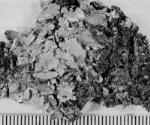
Canoparmelia concrescens (Vain.) Elix, Johnston & Verdon
Canoparmelia concrescens
(Vain.) Elix, Johnston & Verdon,
Mycotaxon 27: 278 (1986).
Syn.:
Parmelia concrescens
Vain., in F. Welwitsch. Cat.
African Pl. Collected by F. Welwitsch in 1853–61, 2, 400
(1901).
Description:
Thallus 4–10 cm wide, adnate, with
rounded, overlapping, 3–6 mm wide, eciliate lobes; upper
surface greenish-grey, cracked in older parts, isidia
moderately dense; lower surface black at centre, becoming
paler tan at lobe margins; rhizines simple, short, extending to
margins. Cortex K+ yellow; atranorin. Medulla K–, C–, KC–
or KC+ faint pink, P-, UV+ white; divaricatic acid. Similar to
C. ecaperata
, but distinguished by the greenish-grey
(atranorin) rather than yellowish upper surface (containing
usnic acid).
Ecology and distribution:
New to Thailand
where it is corticolous in evergreen forest above 1000 m and
in dry dipterocarp forest at 840 m. Reported from S Africa
(HALE 1976b).
102
Medulla KC-
103
102
Medulla KC+ rose/red (gyrophoric)
104
103
Isidia thin, cylindrical, not lobulate
Parmelinopsis expallida (Kurok.) Elix & Hale
Parmelinopsis expallida
(Kurok.) Elix & Hale, Mycotaxon
29: 242 (1987).
Syn.:
Parmelia expallida
Kurok., Bull. Nat. Sci. Mus.,
Tokyo 11: 191 (1968).
Description:
Thallus ± loosely
adnate, 5–7 cm wide, with sparsely ciliate, 1–3 mm wide
lobes; upper surface greenish grey, shiny, with dense,
slender, cylindrical, simple to branched isidia; lower surface
dark brown with pale brown margins; rhizines simple to
sparsely furcate, dense at inner zone. Cortex K+ yellow
(atranorin). Medulla K–, C–, KC–, P–. Distinguished by the
long (to 1 mm) slender isidia that do not become ciliate or
lobulate. Isidiate
Hypotrachyna
species have a black rather
than a brown lower surface.
Ecology and distribution:
Corticolous in an evergreen forest at 1000 m. Also known
from India (DIVAKAR & UPRETI, 2005), Taiwan
(KUROKAWA & LAI 2001) and Nepal (KUROKAWA
1993).
103
Isidia becoming flattened and lobulate
Parmelinopsis microlobulata (D.D. Awasthi) Elix & Hale