Basic HTML Version


45
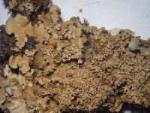
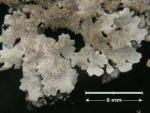
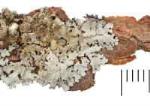
Parmelinopsis microlobulata
(D.D. Awasthi) Elix & Hale,
Mycotaxon 29: 242 (1987).
Syn.:
Parmelia microlobulata
D.D. Awasthi, Biol. Mem. 1:
182 (1977).
Description:
Thallus closely adnate, up to 3 cm
wide, with short, irregularly branched, sparsely ciliate, up to
1(–1.5) mm wide lobes with truncate apices; upper surface
pale to mineral grey, with initially cylindrical isidia that
become flattened and ultimately complex–lobulate and ±
ciliate; lower surface black and sparsely rhizinate. Cortex K+
yellow; atranorin. Medulla K–, C–, KC–, P–; atranorin,
protolichesterinic acid. Distinguished by the presence of fatty
acids and by the dense lobulate isidia.
P. expallida
also has
fatty acids but has long and slender isidia that do not become
lobulate.
Ecology and distribution:
Overgrowing mosses on
rocks in a mixed deciduous forest at c. 1200 m in Phitsanulok
Province, Phu Hin Rong Kla National Park (POOPRANG et
al. 1999), and recorded as corticolous in India (DIVAKAR &
UPRETI 2005).
104
Isidia ciliate
Parmelinopsis horrescens (Taylor) Elix & Hale
Parmelinopsis horrescens
(Taylor) Elix & Hale, Mycotaxon
29: 242 (1987).
Syn.:
Hypotrachyna horrescens
(Taylor) Krog & Swinscow;
Parmelia horrescens
Taylor, in J.T.Mackay, Fl. Hibern. 2:
144 (1836).
Description:
Thallus closely adnate, 2–6 cm
wide, whitish to greenish grey, with lobes often crowded and
imbricate, (sub)linear, 0.5–3 mm wide, lobulate and ciliate;
isidia dense, cylindrical or becoming slightly coralloid–
lobulate, apically spinulose or shorly ciliate; lower surface
black with moderately dense, mostly simple rhizines. Cortex
K+ yellow; atranorin. Medulla K–, C–, KC+ rose/red, P–; 3–
methoxy–2,4–di–O–methylgyrophoric
acid
(major),
gyrophoric acid (minor) and related substances.
Distinguished from
P. minarum
, which is also KC+ red, by
the coralloid–lobulate isidia that become ciliate.
Ecology and
distribution:
Corticolous in an evergreen forest at 1100 m in
Phitsanulok Province, Phu Hin Rong Kla National Park. A
pantemperate and montane pantropical species (ELIX
1994d), occurring on rock and bark.
104
Isidia not ciliate
Parmelinopsis minarum (Vain.) Hale & Elix
Parmelinopsis minarum
(Vain.) Hale & Elix, Mycotaxon 29:
243 (1987).
Syn.:
Hypotrachyna minarum
(Vain.) Krog & Swinscow,
Lichenologist 19: 420 (1987).
Description:
Thallus adnate,
3-7 cm wide, with sublineate-elongate, subdichotomously
branched, sparsely ciliate, 1-3 mm wide lobes; upper surface
mineral to pale green-grey, shiny, with cylindrical, to 0.5 mm
tall, simple to branched, eciliate isidia; lower surface black
with simple or sparingly furcated rhizines. Cortex K+ yellow;
atranorin. Medulla K-, C+ pink, KC+ rose/red, P-; gyrophoric
acid (major), umbilicaric and 5-O-methylhiascic acids
(minor) and related traces. Distinguished by the presence of
gyrophoric acid and from
P. horrescens
by the eciliate isidia.
Ecology and distribution:
Corticolous in an evergreen forest
at 1400 m in Chiang Mai Province, Doi Suthep–Pui National
Park (POOPRANG et al. 1999). Subcosmopolitan, except
Antarctica (ELIX 1994d; DIVAKAR & UPRETI, 2005).