Basic HTML Version


9
AGUIRRE-HUDSON (1997) and BOONPRAGOB et al.
(1998). Our material of
Cetrelia
is presently under revision.
For a distribution map see RANDLANE & SAAG (2004).
7
Without soredia or isidia, often with apothecia
8
7
With soredia or isidia, often without apothecia
44
8
Lobes linear, with parallel margins, attached only at
base
9
8
Lobes rounded to linear, but attached from lower
surface
11
9
Medulla K-. Lobes flattened
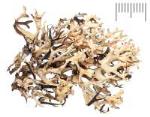
Everniastrum scabridum Elix & Pooprang
Everniastrum scabridum
Elix & Pooprang, Mycotaxon 71:
112 (1999).
Description:
Thallus with 1–2 mm wide, flattened, short
dichotomously to subdichotomously branching lobes; upper
surface lacking vegetative propagules; lower surface
rugulose, pale brown to black, sparsely rhizinate. Cortex K+
yellow; atranorin. Medulla K, C–, KC-, P+ orange–red;
protocetraric acid, protolichesterinic acid and lichesterinic
acid. Distinguished from other congeneric species in northern
Thailand by the absence of medullary salazinic acid.
Ecology
and distribution:
This species has only been reported from
northern Thailand, Chiang Mai province (POOPRANG et al.
1999), where it is corticolous, in undisturbed and slightly
disturbed (open burnt grassland) evergreen forests above
1000 m.
9
Medulla K+ yellow turning red. Lobes distinctly
channelled
10
10
Rhizines only marginal
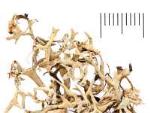
Everniastrum cirrhatum (Fr.) Hale ex Sipman
Everniastrum cirrhatum
(Fr.) Hale ex Sipman, Mycotaxon
26: 237 (1986).
Syn.:
Parmelia cirrhata
E. Fries, Syst. Orb. Veg. 1: 283
(1825).
Description:
Thallus with (strongly) involute, narrow
lobes (0.8–1 mm); upper surface lacking vegetative
propagules; lower surface naked, black (or dark brown) with
paler tips and rhizines ± restricted to the margins. Cortex K+
yellow; atranorin. Medulla K+ yellow turning red, C–, KC-,
P+ orange; salazinic acid and a fatty acid.
E. nepalense
is
densely rhizinate on the lower surface and along margins.
Ecology and distribution:
Corticolous in northern Thailand,
occurring on twigs and branches in undisturbed evergreen
forests and cloud forests, between 1600 and 2565 m. Widely
distributed, reported from the Neotropics, Japan, Taiwan, S
China, Nepal, India, Sri Lanka, Thailand and Réunion
(CULBERSON & CULBERSON 1981).
10
Rhizines marginal and laminal, abundant
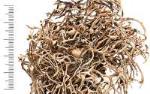
Everniastrum nepalense (Taylor) Hale ex Sipman
Everniastrum nepalense
(Taylor) Hale ex Sipman,
Mycotaxon 26: 239 (1986).
Syn.:
Parmelia nepalensis
Taylor, London Journ. Bot. 6: 172
(1847).
Description:
Thallus with subinvolute to flat, 1–2
mm wide lobes; upper surface lacking vegetative propagules;
lower surface black with brown lobe apices, densely rhizinate
(rhizines continuing along margins). Cortex K+ yellow;
atranorin and chloroatranorin. Medulla K+ yellow turning
red, C–, KC-, P+ orange; containing salazinic acid and a fatty