Basic HTML Version


23
shaped soralia, the perforated upper surface, and by the
chemistry.
Ecology and distribution:
Reported from Chiang
Mai, Doi Inthanon National Park by WOLSELEY &
AGUIRRE-HUDSON (1997). A widespread species of a
genus with the highest diversity in the Southern Hemisphere,
also occurring in Europe; in Asia reported from China, India,
Malaysia, and Taiwan.
46
Soralia not ring-shaped. Medulla KC+ red
47
47
Soralia laminal
Hypogymnia pseudobitteriana (D.D. Awasthi) D.D. Awasthi
Hypogymnia pseudobitteriana
(D.D. Awasthi) D.D.
Awasthi, Geophytology 1: 101 [1971(72)].
Description:
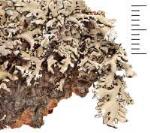
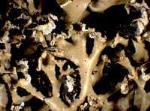
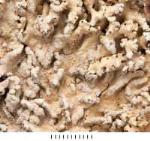
Thallus suberect, lobes inflated, hollow, 1–2
mm wide; upper surface grey, laminal soredia present; lower
surface black, pale brown towards margins, wrinkled, without
rhizines. Cortex K+ yellow; atranorin. Medulla K–, C–, KC+
reddish; physodic and hydroxyphysodic acids. Distinguished
by its inflated, hollow lobes with laminal soredia.
Ecology
and distribution:
Corticolous on twigs and branches of
montane evergreen forests at 1600 m in Chiang Mai
Province, Doi Suthep National Park. Also reported from
India, Taiwan, Papua New Guinea and Australia (AWASTHI
2007).
47
Soralia lip-shaped
Hypogymnia vittata (Ach.) Parrique
Hypogymnia vittata
(Ach.) Parrique, Bull. Soc. linn.
Bordeaux 53: 66 (1898)
Syn.:
Parmelia physodes
v.
vittata
Ach., Meth. Lich.: 250,
(1803).
Description:
Thallus loosely attached; lobes inflated,
hollow, 2–3 mm wide; upper surface grey, with lip-shaped
soralia; lower surface black, wrinkled, without rhizines.
Cortex K+ yellow; atranorin. Medulla K–, C–, KC+ reddish,
P-, UV+ pale violet-blue; physodic, hydroxyphysodic and
vittatolic acids. Distinguished by the inflated, hollow lobes
with lip-shaped soralia.
Ecology and distribution:
Reported
from Chiang Mai, Doi Inthanon National Park by
WOLSELEY & AGUIRRE-HUDSON (1997). A widespread
species, circumboreal, also reported from China, India,
Malaysia, Nepal, and Taiwan.
48
Medulla yellow to ochraceous yellow at least in the
upper or lower part
49
48
Medulla white throughout
52
49
Lobes 0.5-2 mm wide
Myelochroa aurulenta (Tuck.) Elix & Hale
Myelochroa aurulenta
(Tuck.) Elix & Hale, Mycotaxon 29:
240 (1987).
Syn.:
Parmelia aurulenta
Tuck., Am. J. Science & Arts, ser.
2, 25: 424 (1858).
Description:
Thallus 4–10 cm wide,
adnate, lobes 0.5–2 mm wide, sublinear; upper surface
greenish grey, pustulate–sorediate; medulla yellow beneath
soralia and cracks in upper cortex; lower surface black,
densely rhizinate, rhizines simple or sparsely branched.
Cortex K+ yellow; atranorin. Medulla more intensely yellow
with spot tests; secalonic acid A, eumitrins F, D & I, zeorin
& leucotylic acid. Readily distinguishable by the yellow
medulla below soredia.
Ecology and distribution:
Only
found in an evergreen forest at 1350 m in Chiang Mai
Province, Doi Suthep National Park. A pantemperate to