Basic HTML Version


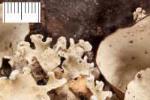
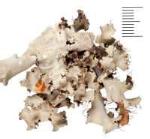
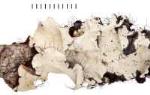
24
pantropical species occurring in all continents except Europe
(LOUWHOFF & ELIX 2002).
49
Lobes >3 mm wide
50
50
Thallus yellowish grey (usnic). Medulla K+ dirty brown, KC-, P+ orange-red
(protocetraric)
Parmotrema dilatatum (Vain.) Hale
Parmotrema dilatatum
(Vain.) Hale, Phytologia 28: 335
(1974).
Syn.:
Parmelia dilatata
Vain., Acta Soc. Fauna Flora fenn.
7(7): 32 (1890).
Description:
Thallus loosely attached, 3–
10(–15) cm wide, with rounded, eciliate lobes 8–13 mm
wide; upper surface yellowish grey, soralia marginal and
linear, or subcapitate on ascending lateral lobes; medulla
white with yellowish pigment in layer below cortex; lower
surface black with paler marginal zone; rhizines sparse.
Cortex K+ yellow; atranorin and usnic acid. Medulla K+
dirty brown, C–, KC-, P+ orange; protocetraric acid (major).
Distinguished by the usnic acid in the cortex and pigmentin
upper layers of medulla.
Ecology and distribution:
Corticolous in disturbed evergreen forests above 1000 m and
mixed deciduous forests at 800 m (Chiang Mai Province, Doi
Suthep National Park; Chiang Rai Province, Khun Lao
Village). Reported from Africa, Asia, S America
(SWINSCOW & KROG 1988), India (DIVAKAR &
UPRETI 2005), the Pacific (ELIX & McCARTHY 2008),
Australia and New Zealand (ELIX 1994e).
50
Thallus grey. Medulla K-, KC+ pink or red, P-
51
51
Lobes with sparse cilia which are 2-4 mm long. Medulla C+ red (gyrophoric)
Parmotrema permutatum (Stirton) Hale
Parmotrema permutatum
(Stirton) Hale, Phytologia 28: 338
(1974).
Syn.:
Parmelia permutata
Stirton, Scott. Nat. 4: 252 (1877–
8).
Description:
Thallus loosely attached and overlapping, to
5 cm wide, lobes rounded, up to 1 cm wide with margins
entire to crenate and dense, cilia 2–4 mm long; upper surface
mineral grey, smooth, emaculate with sorediate margins
giving edges a crinkled appearance; medulla white in upper
part and yellowish below; lower surface black with dark
brown shining marginal zone, rhizines sparse. Cortex K+
yellow; atranorin. Medulla K–, C+ red, KC+ pale red, P–;
gyrophoric acid and unidentified pigment (HALE 1965).
Distinguished from other gyrophoric acid containing species
by the partly ochraceous medulla.
Ecology and distribution:
Corticolous in an evergreen forest at 700–800 m in Chiang
Rai Province, Khun Lao Village. Reported from southern and
eastern Africa, India, Sumatra, Papua New Guinea, Haiti and
Brazil (ELIX 1994e).
51
Lobes with dense cilia which are 3-6 mm long. Medulla C- (alectoronic,
α
–collatolic)
Parmotrema rampoddense (Nyl.) Hale
Parmotrema rampoddense
(Nyl.) Hale, Phytologia 28: 338
(1974).
Syn.:
Parmelia rampoddensis
Nyl., Acta Soc. Sci. Fenn. 26:
7 (1900).
Description:
Thallus up to 15 cm wide, loosely
adnate, lobes irregular, 6–15 mm wide, margins incised with
dense, 3–6 mm long, simple to furcated cilia; upper surface
pale grey to grey with linear or occasionally subcapitate
soralia; medulla white, partly pigmented K+ purple; lower
surface black with brown margin, rhizines sparse, simple.
Cortex K+ yellow; atranorin. Medulla K–, C–, KC+ red, P–,