Basic HTML Version


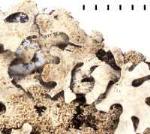
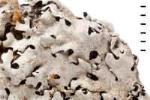
40
norstictic acid and has simple to squarrose rather than
dichotomously branched rhizines.
Ecology and distribution:
A new record for Thailand where it is rare, in an evergreen
cloud forest at 2565 m in Chiang Mai Province, Doi Inthanon
National Park. Reported from India on trees at 1100–2000 m
(DIVAKAR & UPRETI 2005).
91
Upper surface maculate
Hypotrachyna imbricatula (Zahlbr.) Hale
Hypotrachyna imbricatula
(Zahlbr.) Hale, Smithsonian
Contr. Bot. 25: 41 (1975).
Syn.:
Parmelia imbricatula
Zahlbr. Denkschr. Kaiserl. Akad.
Wiss., Math.–Naturwiss, Kl. 83: 168 (1909).
Description:
Thallus adnate, 2–12 cm wide, subdichotomously to
subirregularly branched; lobes 1.5–4 mm wide with truncate
apices and margins often irregularly incised; upper surface
with isidia, rarely becoming lobulate or procumbent; lower
surface black; rhizines richly branched and often projecting
beyond lobe margins. Cortex K+ yellow; atranorin. Medulla
K–, C–, KC+ orange, P–; barbatic acid (major), obtusatic
acid (major/minor), 4–O–demethylbarbatic acid (minor),
norobtusatic acid. Most likely to be confused with
H.
orientalis
, the main difference being in their chemistry.
H.
addita
produces additional echinocarpic acid, not detected in
either
H. imbricatula
or
H. orientalis
.
Ecology and
distribution:
Corticolous in montane oak/chestnut forests at
1500–1600 m, but not as common as
H. orientalis
. A widely
distributed subtropical–tropical species (LOUWHOFF &
ELIX 2002).
91
Upper surface not maculate
92
92
Thallus 1-5 cm wide. Echinocarpic acid present
Hypotrachyna addita (Hale) Hale
Hypotrachyna addita
(Hale) Hale, Phytologia 28: 340
(1974).
Syn.:
Parmelia addita
Hale, Phytologia 22: 433 (1972).
Description:
Thallus to 5 cm wide, lobes sublinear to
subirregular, 1-4 mm wide; upper surface whitish–grey to
grey, isidiate; isidia mostly simple and cylindrical,
occasionally inflated, rarely branched or becoming ±
lobulate; lower surface black with narrow, brown marginal
zone; rhizines dense, often projecting outside of lobe
margins. Cortex K+ yellow; atranorin. Medulla K–, C–, KC+
orange, P–; 4-O-demethylbarbatic acid (major), barbatic acid
(minor), echinocarpic acid (minor/trace) and traces of related
compounds.
H. orientalis
has a larger thallus (5–12 cm vs. 2–
5 cm wide),
H. imbricatula
has a distinctly maculate upper
surface.
Ecology and distribution:
A new record for
Thailand where it was found in a pine/oak forest and in
oak/chestnut forest from 1000 to 1550 m (Chiang Mai
Province, Doi Suthep and Doi Inthanon National Parks).
Reported from the Philippines, Malaysia (HALE 1972),
Australia (ELIX 2001) and Papua New Guinea
(KASHIWADANI 1975, KUROKAWA 1979; LOUWHOFF
& ELIX 2002).
92
Thallus 5-12 cm wide. Echinocarpic acid absent
Hypotrachyna orientalis (Hale) Hale