Basic HTML Version


41
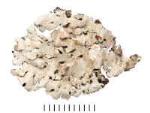
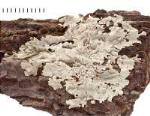
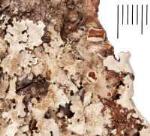
Hypotrachyna orientalis
(Hale) Hale, Phytologia 28: 341
(1974).
Syn.:
Parmelia orientalis
Hale, Phytologia 22: 435 (1971).
Description:
Thallus 5–12 cm wide, (moderately) adnate;
lobes contiguous or becoming subimbricate, 2–3(–5) mm
wide with subtruncate apices and often irregularly incised
margins; upper surface with moderately dense to dense, often
dark–tipped isidia; lower surface densely rhizinate, rhizines
often projecting beyond the lobe margins. Cortex K+ yellow;
atranorin. Medulla K–, C–, KC+ orange, P–; barbatic acid
(major), 4–O–demethylbarbatic acid (submajor/minor),
±pigmentosin B (minor). Distinguished from similar species
primarily by chemistry; from
H. imbricatula
by the absence
of obtusatic and norobtusatic acids, from
H. addita
by the
absence of echinocarpic acid.
Ecology and distribution:
A
common corticolous species on a variety of substrata in
oak/chestnut forests at 1550–1600 m. Reported from Africa
(SWINSCOW & KROG 1988) and SE Asia (HALE 1972;
WOLSELEY et al. 2002), Australia, New Caledonia, and
Papua New Guinea (LOUWHOFF & ELIX 2002).
93
Medulla K+ yellow turning red (salazinic)
94
93
Medulla K- or K+ dirty brown
95
94
Thallus without marginal cilia. Lobes 3-5 mm wide
Canoparmelia salacinifera (Hale) Elix & Hale
Canoparmelia salacinifera
(Hale) Elix & Hale, Mycotaxon
27: 279 (1986).
Syn.:
Parmelia salacinifera
Hale, in Hale & Kurokawa,
Contr. U.S. Natl. Herb. 36: 157 (1964).
Description:
Thallus
adnate, 6–12 cm wide; lobes 3–5 mm wide, eciliate; upper
surface light grey, ± rugulose, moderately isidiate; lower
surface brown to tan; rhizines simple, black, absent from
marginal zone. Cortex K+ yellow; atranorin. Medulla K+
yellow turning red, C–, KC–, P+ pale orange; salazinic acid.
This is the only isidiate
Canoparmelia
species in N Thailand
to produce salazinic acid.
Ecology and distribution:
Corticolous in northern Thailand in a dry dipterocarp forests
at 600 m (Chiang Mai Province, Doi Suthep National Park)
and in a montane evergreen forest on
Pinus kesyia
at 1000 m
(Lampang Province, Doi Khun Tan National Park). Reported
from N, S and Central America and Thailand (HALE 1976b;
WOLSELEY et al. 2002).
94
Thallus with marginal cilia in the axils of lobes. Lobes 5-10 mm wide
Parmelinella wallichiana (Taylor) Elix & Hale
Parmelinella wallichiana
(Taylor) Elix & Hale, Mycotaxon
29: 242 (1987).
Syn.:
Parmelia wallichiana
Taylor, London J. Bot. 6: 176
(1847).
Description:
Thallus 5–10 cm, closely adnate on
bark; lobes 5–10 mm wide, rounded, shortly ciliate in lobe
axils; upper surface grey to grey–green, smooth, e–maculate,
sparsely isidiate; lower surface black to ± brown with a broad
naked or papillate marginal zone; rhizines simple. Cortex K+
yellow; atranorin. Medulla K+ yellow turning red, C-, KC–,
P+ orange–red; salazinic and consalazinic acid. Similar to
Canoparmelia ecaperata
which differs in colour, eciliate
axils and in chemistry.
Ecology and distribution:
Corticolous in a wide range of habitats from dry dipterocarp,
and semi–evergreen forests to pine forests from 650 to 1600
m. Corticolous in Africa, frequently saxicolous in India,
Nepal and Japan (DIVAKAR & UPRETI 2005) and Australia
(McCARTHY 2008).